
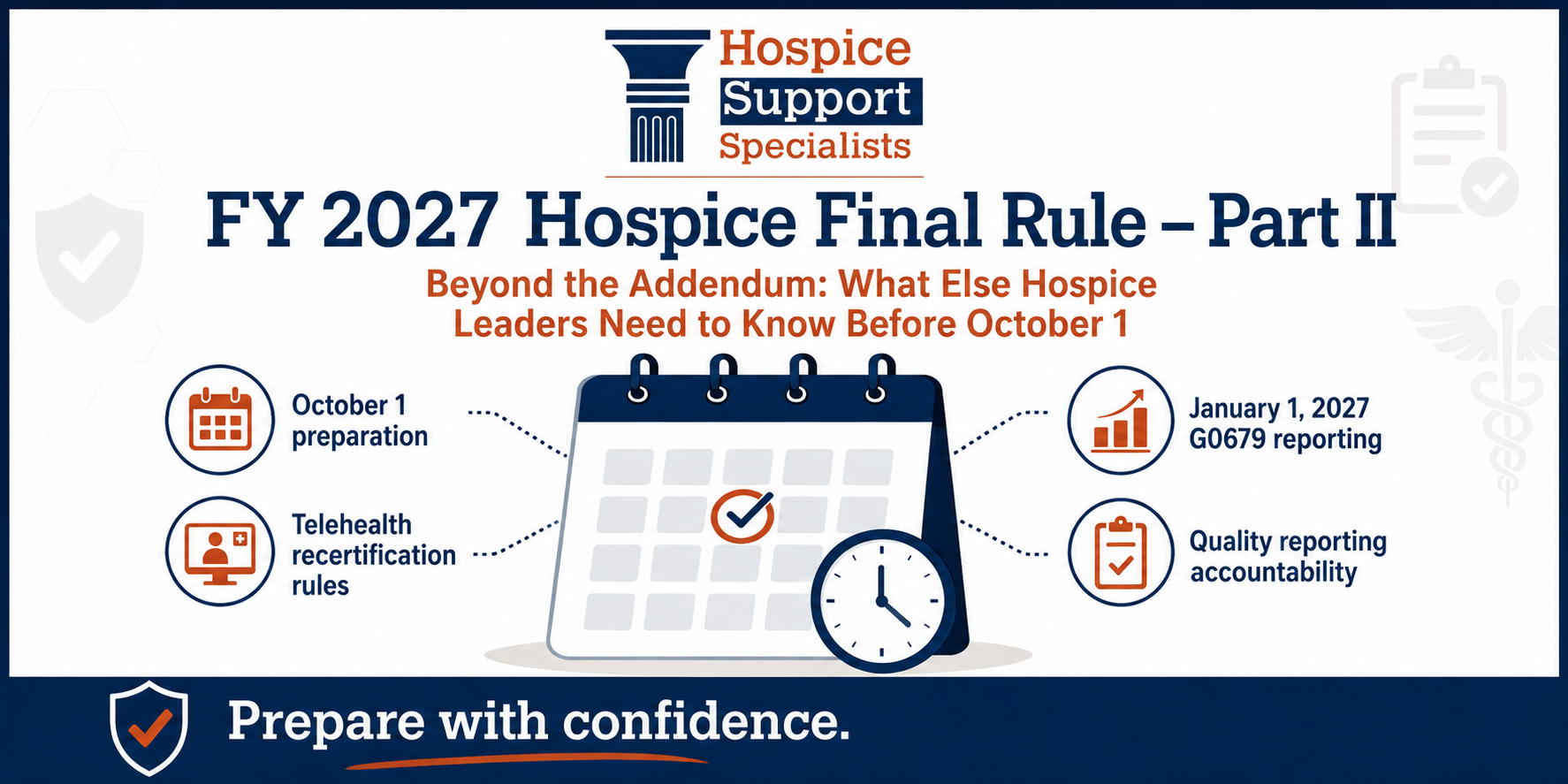
Beyond the Addendum: What Else Hospice Leaders Need to Know Before October 1
In Part I of our FY 2027 Hospice Final Rule series, we focused on what we believe is the most significant operational change facing hospices this year: the mandatory Hospice Election Statement Addendum.
But the Addendum isn’t the only change hospice leaders need to understand.
Fortunately, the remaining changes aren’t nearly as operationally disruptive. Some require policy or workflow changes, while others are extensions or clarifications that should prompt leaders to confirm that current processes remain compliant.
As with Part I, this article isn’t intended to replace your review of the Final Rule. Our goal is much simpler:
What changed, why does it matter, and what should hospice leaders do about it?
1. Face-to-Face Recertifications: Telehealth Continues, but Pay Attention to the Details
Hospices may continue to use telehealth for the required face-to-face encounter through December 31, 2027, when the encounter is conducted by a hospice physician or hospice nurse practitioner for the sole purpose of hospice recertification.
For many organizations, that is welcome news. However, continued access to telehealth does not mean hospices can simply continue doing exactly what they have been doing.
There are several important requirements and changes to understand.
The encounter must include both audio and video
For purposes of the Medicare hospice face-to-face requirement, telecommunications technology must include, at a minimum, two-way, real-time interactive audio and video communication between the patient and the hospice physician or nurse practitioner.
An audio-only encounter does not meet this requirement.
The flexibility applies only to the recertification face-to-face encounter
It should not be interpreted as a general authorization to conduct hospice eligibility assessments or other required encounters remotely.
The face-to-face requirement applies before the third benefit period and each subsequent recertification.
There are circumstances in which telehealth cannot be used
Beginning January 31, 2026, telehealth may not be used for the face-to-face recertification encounter when certain program-integrity conditions apply, including when:
- The hospice is located in an area subject to a hospice enrollment moratorium.
- The hospice is subject to enhanced oversight.
- The physician or nurse practitioner conducting the encounter does not meet Medicare enrollment or opt-out requirements.
CMS has also clarified an important point regarding the current nationwide hospice enrollment moratorium:
Already-enrolled Medicare hospices may continue to use telehealth for face-to-face recertification encounters.
The nationwide moratorium on new hospice enrollments does not, by itself, eliminate this flexibility for existing enrolled providers.
A new claims-reporting requirement begins January 1, 2027
Hospices will be required to report face-to-face recertification encounters performed through telecommunications technology on the hospice claim.
CMS has now issued implementation guidance requiring use of HCPCS code G0679, reported as a separately dated line item under revenue code 0657 on the appropriate hospice claim.
What should hospice leaders do?
- Review current face-to-face recertification policies and procedures.
- Confirm that telehealth encounters consistently use real-time, two-way audio and video.
- Verify physician and nurse practitioner Medicare enrollment or opt-out status, as applicable.
- Determine whether your organization is subject to enhanced CMS oversight that could restrict telehealth use.
- Update EMR and billing workflows for implementation of G0679 beginning January 1, 2027.
- Educate physicians, nurse practitioners, clinical managers, billing staff, and compliance staff.
An HSS Practice Consideration
While CMS continues to permit telehealth for these encounters, organizations should also consider the clinical limitations of evaluating continued hospice eligibility remotely.
Functional decline, nutritional status, physical appearance, symptom burden, caregiver interactions, and other indicators of terminal decline may be more difficult to fully appreciate through a screen.
The HSS compliance team continues to recommend that organizations establish clear criteria for when telehealth is clinically appropriate and when an in-person assessment is warranted.
Convenience or difficulty obtaining a practitioner should not become the primary reason for relying on telehealth when a thorough in-person assessment would provide better information for the recertification decision.
Organizations struggling with in-person coverage should use this temporary extension as an opportunity to build a more sustainable practitioner model, including:
- PRN nurse practitioners and physicians.
- Practitioners with varied availability.
- Greater involvement of hospice physicians in complex or high-risk recertifications.
The takeaway: Telehealth remains available, but the flexibility is temporary and increasingly visible to CMS. Use it appropriately, document it carefully, bill it correctly, and don’t allow the availability of telehealth to substitute for an in-person assessment when the patient’s eligibility would be better evaluated face-to-face.
2. Discharge Authority: A Small Change That Requires a Policy Update
CMS has also aligned the hospice discharge regulations with other hospice payment regulations by expanding who may provide the required written physician discharge order.
Previously, the regulation at §418.26(b) identified the hospice medical director. Under the revised regulation, the written discharge order may now be obtained from:
- Hospice medical director.
- Physician designee.
- Physician member of the interdisciplinary group (IDG).
This is not a major operational change, and for some hospices it may simply bring the regulation into alignment with current practice.
But it is exactly the kind of change that can leave policies, EMR workflows, and actual practice saying three different things.
The change should not be interpreted to mean that every clinical decision associated with a live discharge must now be personally completed by one of these physicians.
Rather, CMS has expanded who may provide the written physician discharge order required under the discharge regulation.
Hospices must still follow all other requirements applicable to the specific type of discharge, including:
- Required notices.
- Documentation.
- Coordination.
- Discharge summary.
Many hospices are receiving survey tags for failing to send the discharge summary to the attending physician, so this is an important reminder to confirm that the summary is completed and sent as required.
What should hospice leaders do?
- Review and update the hospice discharge policy.
- Confirm that EMR workflows and permissions reflect the revised authority.
- Review discharge order templates or forms.
- Educate hospice physicians, clinical managers, and staff responsible for the discharge process.
- Confirm that actual practice matches the updated policy.
The takeaway: This should be an easy fix. Make sure your written policy, EMR, and actual practice all say the same thing.
3. Payment Changes: Know the Numbers
No Final Rule would be complete without a payment update.
For FY 2027, CMS finalized a 2.3% hospice payment update, along with updated wage index data and a corresponding update to the hospice aggregate cap.
CMS estimates the changes will increase aggregate Medicare hospice payments by approximately $755 million compared with FY 2026.
The impact will not be identical for every hospice. Wage index changes and geographic differences mean the 2.3% national update should not simply be interpreted as, “Our hospice will receive 2.3% more.”
Hospices that fail to meet Hospice Quality Reporting Program requirements also continue to face a 4-percentage-point reduction to the annual payment update.
For FY 2027:
- A compliant hospice receives the 2.3% payment update.
- A hospice that fails HQRP requirements receives a 1.7% reduction from the prior year’s rate.
The financial impact can be significant
A hospice that fails HQRP requirements isn’t simply losing part of an increase. It moves from a 2.3% increase to a 1.7% decrease, creating a four-percentage-point difference in reimbursement.
For a hospice receiving approximately $5 million annually in Medicare reimbursement, that difference represents roughly $200,000 in annual revenue before considering sequestration or other payment adjustments.
Medicare sequestration is applied separately.
The HQRP adjustment and sequestration should therefore not simply be added together and described as a single combined percentage penalty.
The important point for leaders is that HQRP noncompliance can create a substantial and completely avoidable loss of Medicare revenue on top of other payment adjustments that already affect reimbursement.
For most clinical and operational managers, there isn’t a lengthy implementation plan associated with this section.
Leadership, finance, and billing teams should, however, understand how the finalized rates affect their own organization.
For those who are failing to meet the 90% required reporting threshold, this problem should be a top priority.
What should hospice leaders do?
- Confirm FY 2027 rates are incorporated into budgets and financial projections.
- Review the impact of wage index changes specific to your service area.
- Review the updated hospice aggregate cap and current cap exposure.
- Ensure billing systems are prepared for the FY 2027 rates.
- Confirm continued compliance with Hospice Quality Reporting Program requirements that affect reimbursement.
The takeaway: Know what the Final Rule means for your numbers—not simply the national payment update.
4. HQRP and HOPE: Don’t Let October 1 Distract You From What’s Already Underway
Not everything important happening in hospice quality reporting is technically new with this Final Rule.
The transition from HIS to HOPE is already underway. HOPE replaced HIS beginning October 1, 2025, and CMS continues moving toward greater transparency and public reporting of hospice quality information.
Hospices must continue meeting applicable HQRP submission requirements, including the 90% timeliness threshold.
In practical terms, at least 90% of required assessments must be submitted to and accepted by CMS within the applicable 30-day timeframe.
That distinction matters.
Sending data is not the same thing as knowing CMS successfully accepted it.
Understanding the Reporting Year and Payment Year
One point that continues to create confusion is the relationship between the year in which quality data are collected and the year in which that performance affects Medicare payment.
Think of it this way:
- CY 2025 reporting performance → FY 2027 payment
- CY 2026 reporting performance → FY 2028 payment
- CY 2027 reporting performance → FY 2029 payment
That means the HOPE and other HQRP data your hospice is submitting today, in 2026, can affect your Medicare payment in FY 2028.
The lag matters.
By the time a hospice experiences the financial consequence of poor reporting, the performance period that caused the problem is long over.
HQRP compliance therefore needs to be actively monitored throughout the year—not reviewed after the fact.
Public reporting is also becoming more important
CMS continues moving toward greater public visibility of reporting performance.
Public reporting of HOPE quality measures is currently expected to begin in November 2027, although CMS notes that the timing may change based on its evaluation of the quality and reportability of CY 2026 data.
Beginning no earlier than FY 2028, CMS will also add an icon to the Medicare.gov Compare Tool identifying hospices that fail to meet HQRP reporting requirements.
The initial determination will be based on CY 2026 submission performance.
In other words, what your hospice is doing now matters not only for future reimbursement, but increasingly for how your organization may be represented publicly.
What should hospice leaders do?
- Confirm someone clearly owns the HOPE/HQRP process.
- Monitor completion and submission timeliness throughout the year.
- Verify that submitted data are actually accepted by CMS.
- Routinely review submission reports and identify errors.
- Monitor the 90% threshold rather than waiting until the end of the reporting period.
- Make sure leadership understands how current reporting performance affects future reimbursement.
- Continue staff education and competency related to HOPE requirements.
The takeaway: Don’t assume that because the EMR submits the data, your hospice is compliant. Someone still needs to own, monitor, and manage the process.
So, What Should Your Hospice Do Now?
None of these changes individually requires the kind of operational redesign we discussed in Part I.
Collectively, however, they touch:
- Clinical practice.
- Physician processes.
- Billing.
- Finance.
- Quality reporting.
- EMR configuration.
- Policies.
- Staff education.
And that creates the same challenge we discussed with the Addendum:
Who owns implementation?
A Final Rule isn’t implemented because someone read it, forwarded an email about it, or updated a policy.
Someone needs to determine what applies, assign responsibility, make the necessary changes, educate the appropriate people, and then verify that the new process is actually working.
Monday Morning Action Plan
- Confirm your Addendum implementation plan from Part I is underway.
- Review your face-to-face recertification policy and telehealth workflow.
- Confirm audio/video, practitioner enrollment, and applicable CMS oversight requirements are met for telehealth FTF encounters.
- Define when your organization will use telehealth versus require an in-person FTF recertification encounter.
- Prepare billing and EMR workflows for G0679 beginning January 1, 2027.
- Educate clinicians, billing, and compliance staff on the revised FTF requirements.
- Review and update your hospice discharge policy, forms, and EMR workflow.
- Educate physicians and clinical managers regarding expanded discharge-order authority.
- Review FY 2027 payment rates, wage index changes, and aggregate cap implications with finance and billing.
- Review current HQRP and HOPE submission performance.
- Confirm your organization understands that CY 2026 reporting performance affects FY 2028 payment.
- Verify someone is monitoring both submission timeliness and CMS acceptance.
- Identify additional staff education and competency needs.
- Assign an accountable owner to each required change.
- Complete a final FY 2027 readiness audit before October 1.
The Final Rule does not require every hospice to rebuild its operations from the ground up.
It does require leaders to know what changed, what applies to their organization, who owns implementation, and how they will know it was actually done.
But implementation is only half of the story.
Throughout the FY 2027 Final Rule, CMS also gives us a tremendous amount of information about what it is watching.
That will be our focus in Part III: What CMS Is Really Watching—And the Red Flags Hospice Leaders Should Be Watching Too.
Need Help Preparing for October 1?
The FY 2027 Hospice Final Rule requires more than policy updates—it requires operational follow-through.
Hospice Support Specialists helps organizations translate Medicare regulations into practical workflows, education, policies, audits, and compliance processes that work in the real world.
Whether you need a focused policy review, workflow redesign, staff education, implementation support, or an objective assessment of your organization’s readiness, Hospice Support Specialists can help your organization prepare with confidence.