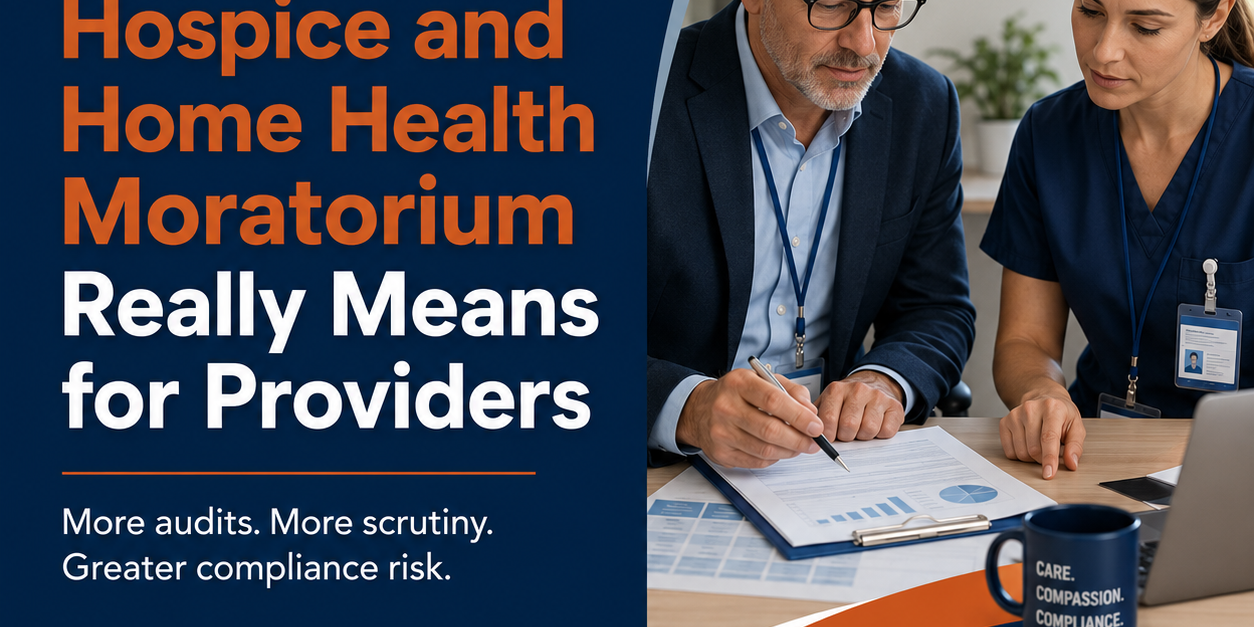
At first glance, the new hospice and home health moratorium may seem like good news. Fewer new providers entering the market could mean less competition and greater stability for existing organizations.
But the reality is far more complex.
While the moratorium limits new entrants, it also signals a dramatic escalation in government oversight across the industry. The real impact will not be felt by providers trying to enter the market — it will be felt by providers already operating within it.
Increased Scrutiny Is Already Here
Over the past several months, we have seen a sharp increase in Medicare audits and investigations, including TPE, SMRC, UPIC, and other aggressive review activity. Many providers are now facing multiple audits simultaneously, creating serious financial and operational strain through:
- Pre-payment claim reviews
- Recoupments
- Appeals
- Delayed cash flow
- Heightened documentation demands
- Cost of expert support through lawyers and consulting companies
Denial rates continue to rise, and appeals are becoming increasingly difficult to win.
In a CMS Newsroom article published May 13, 2026, CMS Administrator Dr. Mehmet Oz stated that CMS is focused on “preventing new bad actors from entering Medicare while aggressively identifying, investigating and removing those already exploiting the system.”
CMS further announced that during the six-month moratorium it will:
- Intensify targeted investigations
- Expand advanced data analytics monitoring
- Accelerate provider revocations and deactivations
- Conduct nationwide site visits
- Increase oversight in high-risk states including California, Arizona, Nevada, Texas, Georgia, and Ohio
- Expand home health pre- and post-claim review demonstrations in Florida, Illinois, Oklahoma, Ohio, North Carolina, and Texas
This is not routine oversight. The level of enforcement activity is far more aggressive than what providers experienced even a few years ago.
“But We Aren’t Committing Fraud”
This is one of the most common responses we hear from providers under investigation.
The truth is, we have never worked with a client who believed they were intentionally committing fraud. Most organizations are staffed by caring professionals who are genuinely trying to provide quality patient care and comply with regulations.
Unfortunately, intent is not what CMS evaluates.
CMS evaluates documentation, eligibility support, billing practices, and compliance with Conditions of Payment. If those standards are not met, providers can still face allegations of improper billing, overpayments, or fraud — regardless of intent.
Many organizations unknowingly operate with:
- Inconsistent eligibility practices
- Weak pre-bill review processes
- Insufficient clinician training
- Documentation gaps
- Delayed discharge planning for patients who no longer qualify
The regulatory environment has changed. What may have once been viewed as “gray area” decision-making is now being heavily scrutinized.
What Providers Should Be Doing Right Now
Organizations that act proactively now will be far better positioned to withstand audits, reviews, and investigations later.
Here are the most important steps providers should take immediately:
- Strengthen Your Pre-Bill Audit Process
A robust pre-bill review system is no longer optional. Your audit process should be designed and validated by true compliance experts with current experience managing Medicare enforcement activity — not simply internal assumptions or outdated practices.
These are not the audits of 2015.
- Bring in an Independent Third Party
If you are uncertain about the strength of your pre-bill auditing and compliance programs, now is the time to engage outside experts. Independent reviews can identify vulnerabilities before regulators do. Hire someone to audit your claims for you – this will save you time and money in the long run.
The upfront investment can save enormous financial and operational costs later.
- Re-Train Clinicians on Eligibility Requirements
Train and re-train your clinicians and practitioners on the eligibility guidelines as defined in the LCD. Eligibility standards must be consistently understood and applied across the organization. Clinicians and practitioners should receive ongoing education tied directly to LCD requirements and current enforcement trends.
The era of “grey area patients” and “watch and wait” hospice admissions is over.
- Audit Documentation Continuously
Documentation should be reviewed regularly, and education should occur continuously. Strong clinical care must be matched by strong clinical documentation.
- Establish Rapid Response Processes
Organizations need clear procedures for identifying and managing patients who may no longer qualify for services. Delayed discharge decisions can quickly become significant liability exposures.
- Invest in True Expertise
Hire experienced specialists to train staff, conduct audits, reinforce compliance processes, and guide corrective action plans. Expertise matters — especially in today’s enforcement environment.
- Conduct a 360 Degree Comprehensive Compliance Risk Assessment
Many providers focus heavily on Conditions of Participation and survey readiness while overlooking Conditions of Payment compliance.
A comprehensive third-party compliance risk audit — including onsite operational review – can uncover hidden vulnerabilities and reduce exposure before issues escalate and eliminates internal bias. Your team do not believe that they are doing anything wrong, so how can they audit for errors?
- Do Not Respond to Audits Alone
One of the biggest mistakes providers make is attempting to manage audits or investigations without experienced guidance.
We are often contacted after organizations have already made critical response errors that worsened their situation. By the time outside support is engaged, the damage can be far more difficult – and expensive – to correct.
Early intervention matters. Waiting to engage help until you are in trouble exponentially decreases the likelihood that you will come through any audit unscathed.
The Bottom Line
The investigative climate surrounding hospice and home health is becoming increasingly aggressive, and providers should expect continued escalation over the next six months and potentially even longer.
Organizations that prioritize compliance, strengthen internal processes, and seek expert guidance now will be in a far better position to reduce risk and protect their future.
As one of our clients recently said:
“We can either pay you now or pay you and the government a lot more later.”
The months ahead will be challenging for many providers. But organizations committed to doing the right things, the right way, for the right reasons can successfully navigate this environment with the right support and strategy.
Hospice Support Specialists is actively helping providers across the country respond to audits, strengthen compliance programs, and reduce operational risk before problems become crises.