Understanding the New Service and Spending Variation Index—and What Hospice Leaders Should Do Next
Throughout our FY 2027 Hospice Final Rule series, we have talked about something bigger than individual regulatory changes: CMS is increasing its ability to see, compare, and act on what is happening inside hospice organizations.
The newly released Service and Spending Variation Index (SSVI) may be one of the clearest examples yet.
CMS has now published provider-level SSVI data for FY 2024 and FY 2025. That means hospice leaders can see their organization’s score—and, perhaps more importantly, the individual utilization and spending measures that contributed to it. CMS also says it plans to determine the SSVI for individual hospices each fiscal year using that year’s data.
So, this isn’t simply another national hospice statistic buried in the Final Rule.
CMS has built a data profile of your hospice. And you can now see what CMS sees.
What Is the SSVI?
The Service and Spending Variation Index is a claims-based scoring system developed by CMS to examine hospice utilization patterns and Medicare spending outside of the hospice benefit while a beneficiary is under a hospice election.
CMS created the index amid its growing concerns about fraud, waste, abuse, quality, and compliance in hospice. According to CMS, the SSVI can identify patterns that may signal potentially inappropriate utilization or other concerns and may help identify hospices that warrant additional education or oversight.
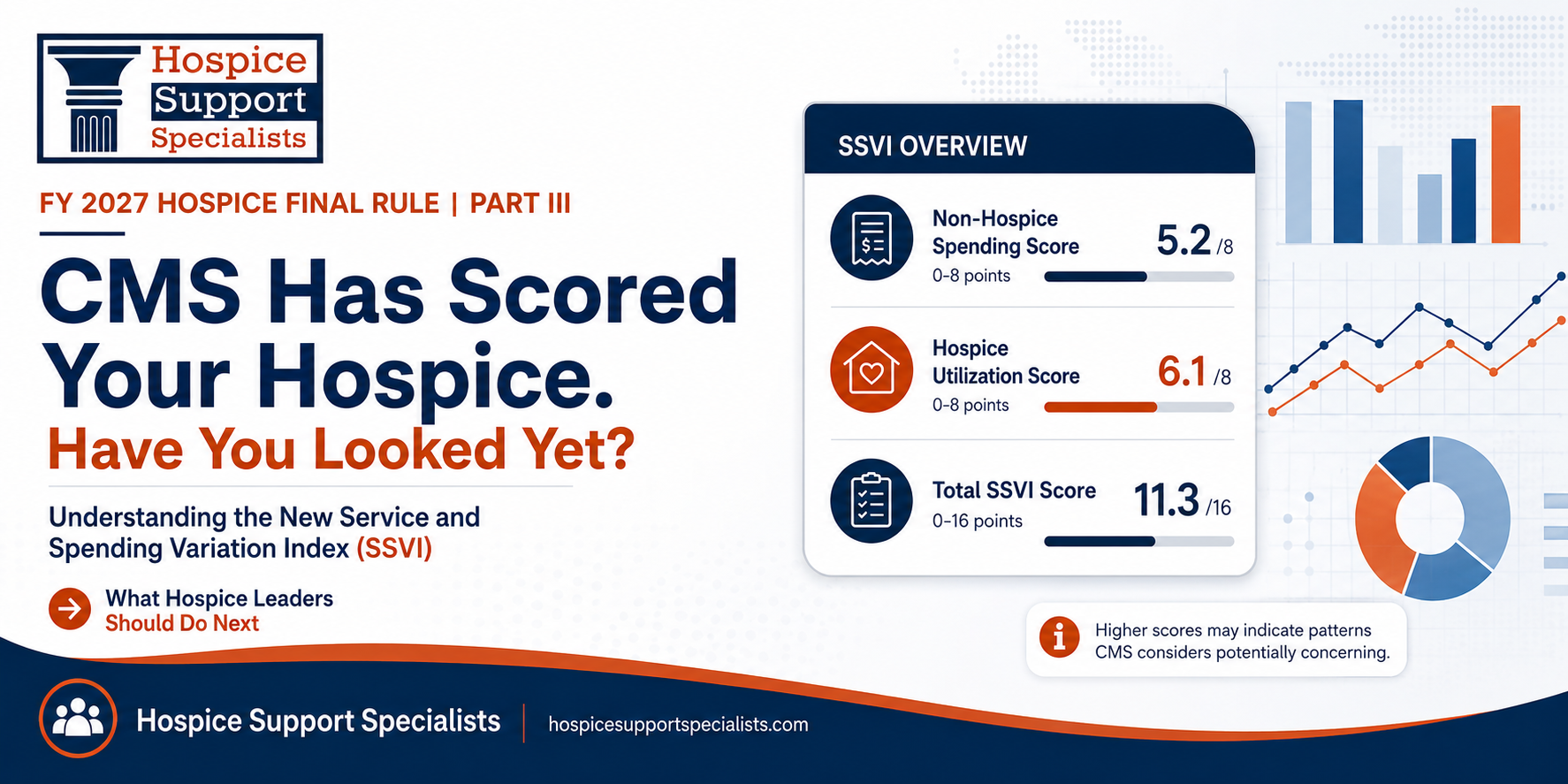
The SSVI produces three scores:
Non-Hospice Spending Score: 0–8 points
Hospice Utilization Score: 0–8 points
Total SSVI Score: 0–16 points
A higher total score reflects a greater combination of the spending and utilization patterns CMS has identified as potentially concerning.
That does not mean a higher score automatically establishes wrongdoing, poor care, or noncompliance. But it does tell you that your hospice’s claims data are demonstrating patterns CMS has specifically decided are worth watching.
And that should get leadership’s attention.
What Exactly Is CMS Looking At?
The utilization portion of SSVI examines eight separate hospice measures. A hospice can receive one point for each measure when it meets the applicable threshold.
For FY 2025, CMS evaluated whether a hospice:
- provided neither Continuous Home Care (CHC) nor General Inpatient Care (GIP) during the year;
- provided 40% or more of its Routine Home Care (RHC) days in nursing facilities or SNFs;
- had a rate of skilled visits during the final two RHC days of life of 87.5% or less;
- had 33.3% or more of applicable discharges involving beneficiaries with a length of stay of 180 days or longer;
- had a live discharge rate of 47% or greater;
- averaged 9.9 or fewer skilled nursing minutes per RHC day;
- provided a skilled visit on 4.8% or fewer weekend RHC days; or
- had 18.2% or more of live discharges followed by the beneficiary returning to the same hospice within seven days.
Look at that list again—not as eight isolated statistics, but as a picture of a hospice.
CMS can see your level-of-care utilization.
CMS can see where you provide care.
CMS can see how much nursing care your patients receive.
CMS can see whether patients receive skilled visits near death and on weekends.
CMS can see your long lengths of stay.
CMS can see your live discharges.
And CMS can see when those patients come back.
This is why hospice leaders need to understand their data before someone outside the organization begins asking questions about it.
Then There Is the Other Half of SSVI: Non-Hospice Spending
This may be the more significant piece.
CMS is also looking at Medicare payments for non-hospice services provided while beneficiaries are under a hospice election.
The SSVI assigns between zero and eight points based on the hospice’s total non-hospice spending. For FY 2025, hospices with more than $538,406 in total non-hospice spending receive the maximum eight spending points.
Why does CMS care?
Because the Medicare Hospice Benefit is intended to be comprehensive. CMS has repeatedly maintained that it should be unusual for a terminally ill beneficiary to routinely need items, services, or drugs outside of the hospice benefit. CMS reports that non-hospice spending has nevertheless continued to increase.
And this is where two major pieces of the FY 2027 Final Rule intersect.
SSVI and the New Mandatory Election Statement Addendum Are Connected
The FY 2027 Final Rule also finalized a significant change to the hospice election statement addendum.
Previously, the addendum was required when requested by the beneficiary or representative. Beginning under the new FY 2027 requirement, hospices must provide the addendum to all Medicare beneficiaries at the time of hospice election. The addendum identifies the conditions, items, services, and drugs the hospice has determined are unrelated to the terminal illness and related conditions—and therefore not covered by the hospice.
CMS specifically connected this change to its concern about rising non-hospice Medicare spending.
That connection should not be missed.
CMS is simultaneously requiring hospices to be more transparent about what they consider unrelated and examining claims data showing what Medicare is paying outside the hospice benefit.
This makes relatedness more than an admission-form issue.
Hospices need a defensible process for determining what is related and unrelated, documenting those decisions, communicating them to patients and families, and revisiting them as the patient’s condition changes.
A beautifully completed addendum will not fix a poorly supported relatedness determination.
Your Score Is Only the Beginning
One of the most useful things CMS has done is publish more than a single SSVI number.
The downloadable Excel workbook contains separate tabs for:
Total SSVI Score – showing each hospice’s FY 2024 and FY 2025 spending, utilization, and total scores.
FY 2025 Data – containing the underlying utilization and spending information.
FY 2025 Scoring Components – showing exactly which measures contributed points to the hospice’s score.
Equivalent data and scoring-component tabs are also available for FY 2024.
That means leadership shouldn’t simply find the hospice name, look at the total score, breathe a sigh of relief—or panic—and close the spreadsheet.
The components are where the real work begins.
Pull Your Hospice’s SSVI Data
CMS has made the provider-level SSVI workbook and methodology available on its FY 2027 Hospice Final Rule page:
Download the CMS Service and Spending Variation Index (SSVI) data
On that page, look under Downloads for:
Service and Spending Variation Index (SSVI) – the Excel workbook containing provider-level FY 2024 and FY 2025 data.
FY 2027 Final SSVI Overview – CMS’s methodology and explanation of the measures and scoring system.
CMS is also maintaining SSVI information through its Hospice News & Announcements page:
CMS Hospice News & Announcements – SSVI Data
What Should Hospice Leaders Do Now?
The SSVI gives hospice leaders something valuable: an opportunity to see some of the same data CMS is reviewing and take action before concerning patterns become larger problems.
Your SSVI Action Checklist
Pull your hospice’s FY 2024 and FY 2025 SSVI data.
Don’t wait for compliance, billing—or CMS—to tell you what your score is. Identify your organization by CCN and review both years of available data.
Look beyond the total score.
Review the non-hospice spending and utilization scores separately, then examine the scoring-component tabs to identify exactly which measures contributed points to your organization’s score.
Compare FY 2024 to FY 2025.
Don’t look at either year in isolation. Identify measures that improved, worsened, or remained persistent. A trend may tell you considerably more than a single year’s score.
Investigate the “why” behind every outlier.
Crossing an SSVI threshold does not automatically mean your hospice has done something wrong. But leadership should understand why the pattern exists and determine whether clinical practice, operations, and the medical record support what the claims data are showing.
Take a closer look at non-hospice spending and relatedness.
Evaluate how your organization determines relatedness, who makes those decisions, how they are documented and communicated, and how services furnished outside the hospice are identified and monitored. With the FY 2027 mandatory election statement addendum, this deserves particular attention.
Connect the data back to actual patients and processes.
Numbers alone don’t tell you what needs to change. If your data reveal concerns with long length of stay, live discharges, weekend or end-of-life visits, nursing utilization, higher levels of care, facility concentration, or patients returning shortly after discharge, drill down to determine what is driving the pattern.
Bring SSVI into your compliance, QAPI, and leadership oversight.
These metrics should not live in a CMS spreadsheet that gets reviewed once a year. Determine which measures should become part of routine compliance monitoring, QAPI activities, focused audits, or your leadership dashboard.
Develop a strategic action plan for identified vulnerabilities.
Define what needs to change, who owns the work, how improvement will be measured, and when leadership will reassess the data. An identified outlier without a plan to understand and address it is simply an identified risk.
Don’t manage to the threshold.
The goal isn’t to keep your live discharge rate one percentage point below CMS’s benchmark or add just enough nursing minutes to avoid an SSVI point. CMS designed SSVI to identify patterns across multiple measures. Use the data to understand whether your organization is delivering appropriate, comprehensive hospice care—and whether your claims data support that story.
Not Sure What Your Data Are Telling You?
Finding your SSVI score is the easy part. Understanding why your organization scored the way it did—and what to do about it—is where the real work begins.
The Hospice Support Specialists team is experienced in analyzing hospice claims, utilization, quality, compliance, and operational data and translating those numbers into meaningful action. We can help identify the patients, practices, and processes driving your outliers, determine where true risk exists, and develop a practical strategic action plan to address vulnerabilities—because the goal isn’t simply to improve a score. It’s to correct what is driving it.
The Bigger Message From CMS
For FY 2025, CMS calculated SSVI scores for 6,673 hospices using more than 6.7 million hospice claims and nearly 157 million hospice days. Only 69 hospices scored 13 or higher, placing them roughly in the highest one percent of the distribution.
But that doesn’t mean only those 69 organizations should be paying attention.
SSVI joins a growing collection of claims, quality, utilization, survey, and program-integrity data CMS can use to understand hospice performance without ever opening a medical record. And CMS intends to calculate SSVI annually.
Don’t treat SSVI as another CMS score to file away. Pull it. Understand it. Compare it. Investigate it. And use it.
The organizations best positioned for the next phase of hospice oversight won’t necessarily be those with perfect numbers. They’ll be the ones that understand their data, can explain why their patterns exist, recognize when those patterns reveal genuine vulnerabilities, and act on them.
Because CMS does not have to walk through your front door to see what is happening inside your hospice.
Your claims are already telling a story.
The question is whether you know what that story says—and whether you’re comfortable with CMS reading it.